Free Calculators Hub
CPC ROI and Paid Campaign Profit Calculator
Models clicks purchased at an entered average CPC, applies an entered conversion rate, then compares modeled revenue with ad spend and variable conversion costs.
Limitation: This is a deterministic scenario model, not a forecast.
How to Model CPC Campaign ROI
Keep every monetary input in one currency and use data from the same attribution window.
Enter the number of paid clicks and average cost per click.
Use contribution economics
Variable cost per conversion prevents gross revenue from being mistaken for profit. Add fixed overhead separately when evaluating the wider business.
What the CPC ROI Result Means
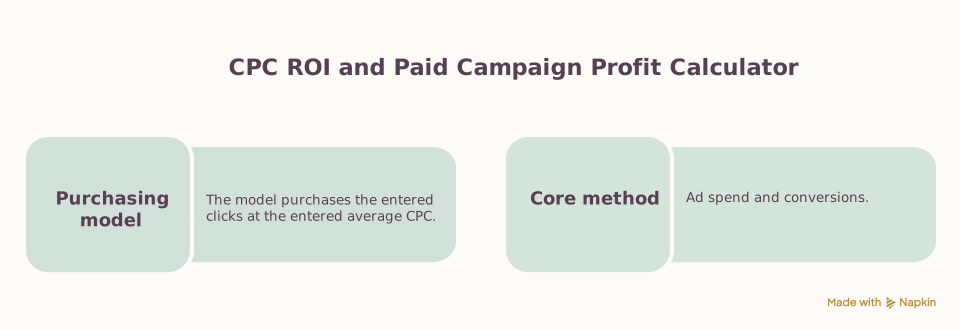
The model purchases the entered clicks at the entered average CPC. Fractional modeled conversions are allowed because conversion rate is an expected average. ROI uses ad spend plus conversion-linked variable costs as the denominator; ROAS uses ad spend alone. A negative ROI means modeled revenue does not recover those included costs.
Paid Campaign ROI Examples
Positive contribution campaign
Traffic and unit economics
Modeled ROI
Ad spend is 2,000; 50 modeled conversions produce 5,000 revenue and 1,000 variable costs. Profit is 2,000 on 3,000 total modeled investment.
Traffic with no conversions
Traffic and unit economics
Modeled ROI
The 125 ad spend produces no modeled revenue, so the included investment is fully unrecovered.
Compare like with like
Use one attribution window and one revenue definition across the clicks, conversions, and monetary inputs.
Frequently Asked Questions
Still have questions about this calculation?
Try the CalculatorCPC ROI, Profit, and ROAS Formulas
Google Ads defines average CPC as total click cost divided by clicks. This model uses that observed or assumed unit cost to build a separate profitability scenario.
Formula
Ad spend and conversions
ad spend = clicks × average CPC; conversions = clicks × conversion rate ÷ 100
Campaign ROI
ROI = (revenue − ad spend − variable costs) ÷ (ad spend + variable costs) × 100
ROAS
ROAS = revenue ÷ ad spend
Scientific Background
The arithmetic is deterministic and uses no benchmark conversion rate, click price, attribution model, or lifetime-value assumption.
Sources & review
CPC ROI Calculator documents the references behind its formulas and assumptions. Always treat results as educational estimates, not personalized professional advice.
Last reviewed
July 22, 2026
Reference
support.google.com
https://support.google.com/google-ads/answer/14074?hl=enFree Calculator Hub methodology
Free Calculator Hub
/methodology
See our methodology and corrections policy.