Free Calculators Hub
Percentage Increase and Change Calculator
Subtracts the original value from the new value, divides by the absolute original value, and multiplies by 100 to produce a signed percentage change.
Limitation: Percentage change is directional and depends on which value is chosen as the baseline.
How to Calculate Percentage Increase
Enter the original baseline first and the later or comparison value second. A positive result is an increase, a negative result is a decrease, and zero means no change.
Enter the original non-zero value.
Order matters
An increase from 80 to 100 is 25%, but a decrease from 100 to 80 is 20%. Each calculation uses a different original baseline.
Percentage Increase, Decrease, and No Change
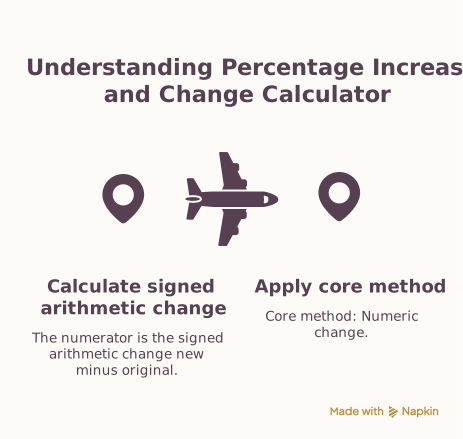
The numerator is the signed arithmetic change: new minus original. Dividing by the absolute magnitude of the original keeps the direction controlled by that numerator even when the baseline is negative. This explicit convention makes a move from −50 to −40 a positive 20% change. A zero original value is rejected because division by zero cannot produce a finite percentage change. The percentage is rounded to at most six decimal places and the numeric change to at most ten.
Percentage Change Examples
Price or count increase
Original and new values
Signed percentage change
The change is 20, and 20 divided by the original 80 equals 0.25.
Measured decrease
Original and new values
Signed percentage change
The signed change is −50; dividing by 200 and multiplying by 100 gives −25%.
Negative baseline convention
Original and new values
Signed percentage change
The numeric change is +10 and the denominator is the original magnitude, 50.
Name the baseline
Include the original period, price, or measurement in reports so readers can reproduce the percentage.
Frequently Asked Questions
Still have questions about this calculation?
Try the CalculatorPercentage Increase Formula
The original value supplies the comparison base, while the subtraction supplies direction.
Formula
Numeric change
change = new value − original value
Signed percentage change
percentage change = change ÷ |original value| × 100
Scientific Background
Percent change is a relative, baseline-dependent measure. Percentage difference instead divides an absolute difference by an average magnitude and answers a different, non-directional question.
Sources & review
Percentage Increase Calculator documents the references behind its formulas and assumptions. Always treat results as educational estimates, not personalized professional advice.
Last reviewed
July 21, 2026
Free Calculator Hub methodology
Free Calculator Hub
/methodology
See our methodology and corrections policy.