Free Calculators Hub
Build a Transparent Weekly Workout Rotation
Creates a deterministic weekly rotation for six broad muscle groups using the user's session count, target frequency, and first training day.
Limitation: This calculator creates a scheduling template, not an individualized exercise prescription.
How to Create the Workout Split
Choose scheduling constraints you have already decided. The calculator distributes muscle-group labels and does not prescribe training dose.
Select the number of sessions you can schedule each week.
Frequency is not volume
Training a group twice per week does not define how many exercises, sets, repetitions, or hard efforts belong in either session.
A Deterministic Muscle-Group Rotation
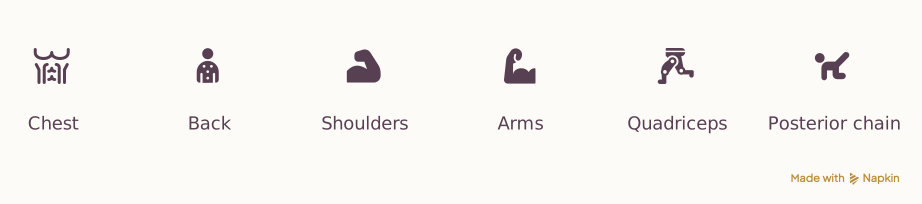
The tool assigns Chest, Back, Shoulders, Arms, Quadriceps, and Posterior chain to session slots. It spaces the chosen number of sessions across seven days and reports the exact group frequency produced.
Workout Split Examples
Four sessions and two exposures
Sessions, frequency, and first day
Weekly muscle-group rotation
Every listed muscle group appears in exactly two session rows, for 12 total group exposures.
Two full-body-style sessions
Sessions, frequency, and first day
Weekly muscle-group rotation
Two exposures across two sessions necessarily place every broad group in each session.
Review feasibility
If a generated session contains too many groups for your available time, reduce frequency or choose more weekly sessions; the tool does not alter volume for you.
Frequently Asked Questions
Still have questions about this calculation?
Try the CalculatorWorkout Rotation Scheduling Rule
The implementation uses modular assignment so the selected group frequency is exact and training days are distributed across the week.
Formula
Training day index
dayIndex = firstDay + floor(sessionIndex × 7 / sessionsPerWeek)
Group exposure count
total exposures = 6 groups × selected weekly frequency
Scientific Background
Resistance-training frequency is one programming variable discussed in the research literature, but outcomes also depend on total volume, intensity, exercise selection, effort, experience, and adherence. This calculator exposes scheduling arithmetic only and does not convert population research into a personal recommendation.
Sources & review
Workout Split Calculator documents the references behind its formulas and assumptions. Always treat results as educational estimates, not personalized professional advice.
Last reviewed
July 21, 2026
NIH health reference
National Institutes of Health (NIH)
https://pubmed.ncbi.nlm.nih.gov/29073412/
See our methodology and corrections policy.