Free Calculators Hub
Retention-Based Customer Lifetime Value Calculator
Applies a constant-retention discounted CLV model to per-period contribution margin and separately subtracts entered customer acquisition cost.
Limitation: This is a simplified stationary cohort model, not a valuation or forecast.
How to Estimate Customer Lifetime Value
All recurring inputs must use the same period: monthly with monthly, quarterly with quarterly, or annual with annual.
Choose a currency for display only.
Use cohort evidence
Retention and margin averages can hide large differences by acquisition channel or customer cohort. Calculate separate scenarios when behavior differs materially.
What This CLV Model Measures
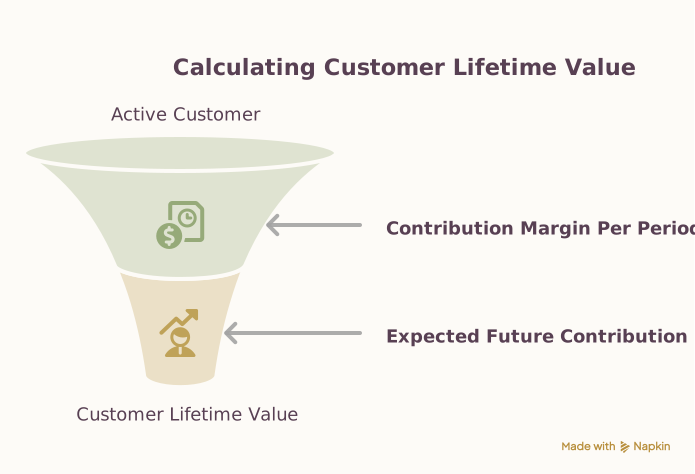
The calculator values expected future contribution from a customer who is active now. Each future period is weighted by constant retention and discounted. Gross CLV is before acquisition cost; net CLV subtracts CAC once. The ratio divides gross CLV by CAC and is undefined when CAC is zero.
Customer Lifetime Value Examples
Monthly constant-retention scenario
Per-period cohort assumptions
Discounted future CLV
Per-period contribution is 80. The constant-retention discounted future series equals 360 before CAC.
No next-period retention
Per-period cohort assumptions
Discounted future CLV
This formulation values future retained periods, so zero retention produces no future contribution.
Match period lengths
Do not combine monthly retention with an annual discount rate without converting one to the other's period.
Frequently Asked Questions
Still have questions about this calculation?
Try the CalculatorConstant-Retention CLV Formula
Gupta, Lehmann, and Stuart describe the constant-margin, constant-retention discounted relationship used here. Rates are entered as percentages and converted to decimals.
Formula
Contribution margin per period
m = revenue per customer × gross margin rate
Gross future CLV
CLV = m × r ÷ (1 + i − r)
Net CLV and ratio
net CLV = gross CLV − CAC; ratio = gross CLV ÷ CAC
Scientific Background
The closed form converges when 1 + discount rate − retention is positive. A 100% retention rate therefore requires a positive discount rate. Real customer behavior is rarely stationary, so cohort cash-flow models are preferable when data supports them.
Sources & review
Customer Lifetime Value Calculator documents the references behind its formulas and assumptions. Always treat results as educational estimates, not personalized professional advice.
Last reviewed
July 22, 2026
Reference
doi.org
https://doi.org/10.1509/jmkr.43.1.139Free Calculator Hub methodology
Free Calculator Hub
/methodology
See our methodology and corrections policy.