Free Calculators Hub
Compound Interest with Recurring Contributions
Projects a balance from principal and recurring cash contributions using a user-entered nominal annual rate and compounding frequency.
Limitation: Educational projection only.
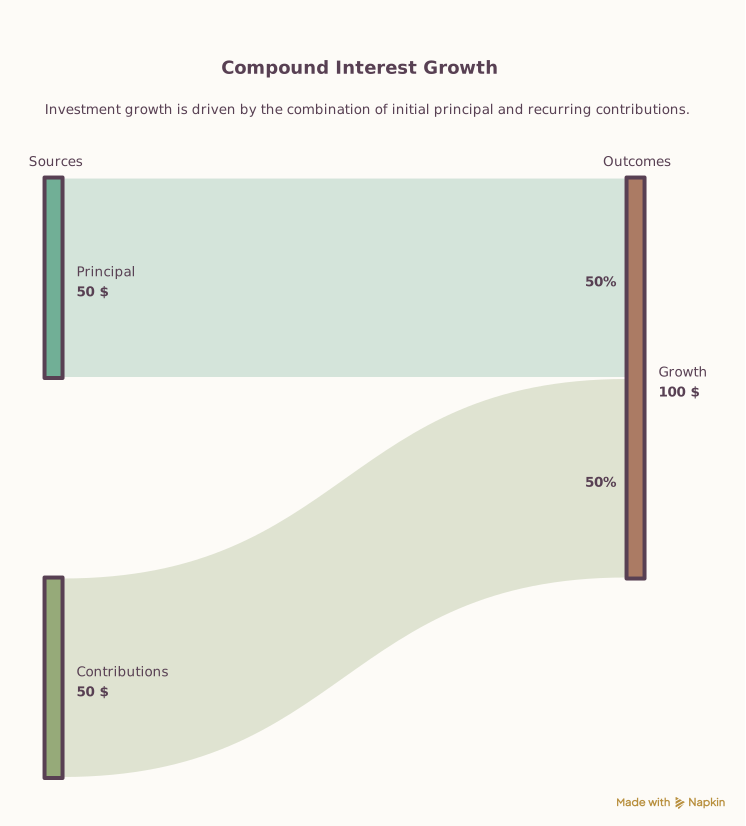
How to Build a Compound-Growth Scenario
Use one currency throughout. Enter a hypothetical nominal annual rate and cash-flow schedule that match the scenario you want to inspect.
Select a display currency; no exchange conversion is performed.
Timing changes the math
A beginning-of-period contribution receives one additional contribution period of growth compared with the same end-of-period contribution.
A Cash-Flow Calculation, Not a Product Forecast
This page targets the mathematical compound-interest intent: principal plus optional recurring contributions, a nominal annual rate, compounding frequency and contribution timing. The model derives an effective growth factor for each evenly spaced contribution period. It keeps the entered rate constant and does not infer market returns, deposit rates, risk, taxes or fees. The currency selector changes formatting only.
Compound Growth Examples
Lump sum with monthly compounding
Entered cash flows
Projected ending balance
The balance uses 120 monthly compounding periods and no additional cash flows.
Monthly contributions
Entered cash flows
Projected ending balance
$3,400 is principal plus contributions; $270.36 is mathematical growth under the fixed-rate assumption.
Compare assumptions
Change one input at a time to see whether rate, time, frequency or contributions caused the difference.
Frequently Asked Questions
Still have questions about this calculation?
Try the CalculatorCompound Interest and Contribution Formula
The implementation applies one consistent effective rate to each contribution interval and explicitly handles a zero rate.
Formula
Principal growth
A = P(1 + r/n)^(nt)
Contribution-period rate
i = (1 + r/n)^(n/f) − 1
Period update
end timing: Bₖ = Bₖ₋₁(1+i)+C; beginning timing: Bₖ = (Bₖ₋₁+C)(1+i)
Scientific Background
Investor.gov describes compound interest as interest earned on principal and accumulated interest. This implementation is deterministic and uses only the assumptions entered.
Sources & review
Compound Interest Calculator documents the references behind its formulas and assumptions. Always treat results as educational estimates, not personalized professional advice.
Last reviewed
July 21, 2026
Digital assets investing basics
U.S. Securities and Exchange Commission — Investor.gov
https://www.investor.gov/financial-tools-calculators/calculators/compound-interest-calculatorReference
sec.gov
https://www.sec.gov/investor/pubs/sec-guide-to-savings-and-investing.pdfFree Calculator Hub methodology
Free Calculator Hub
/methodology
See our methodology and corrections policy.