Free Calculators Hub
Fixed Annuity Payout from Present Value
Solves the present-value annuity equation for a fixed periodic payout and models ordinary or due timing.
Limitation: Educational present-value calculation only.
How to Estimate a Fixed Payout
Enter one deterministic present-value scenario. Do not substitute the result for an insurer's contract illustration or disclosure.
Select a display currency; the calculator performs no conversion.
Confirm timing first
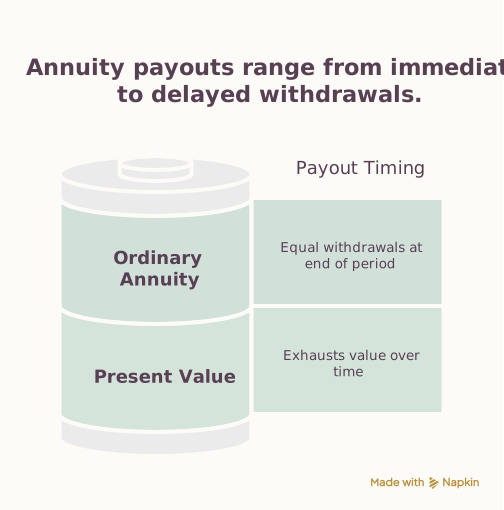
A due payout occurs one period earlier than an ordinary payout. With a positive rate, that makes each sustainable due payout lower for the same present value and term.
A Present-Value Equation, Not an Insurance Illustration
This page solves for equal withdrawals that exhaust a present value over a fixed number of periods under a constant nominal rate. Ordinary timing applies interest before each end-of-period payout. Due timing pays first, then applies interest to the remaining balance. The result is not based on age, life expectancy, mortality pooling, insurer expenses, riders or contract guarantees, so it must not be interpreted as an immediate-annuity quote.
Fixed Payout Examples
Ten-year ordinary monthly payout
Present-value assumptions
Estimated payout
The equation models 120 equal end-of-month payouts and a fixed 0.5% monthly rate.
Zero-rate payout
Present-value assumptions
Estimated payout
With no interest, present value is divided evenly by the 12 payouts.
This is not a quote
Compare the result only with a contract illustration that documents product-specific charges, guarantees and payout terms.
Frequently Asked Questions
Still have questions about this calculation?
Try the CalculatorPresent-Value Annuity Formula
The fixed payout is derived from present value, periodic rate, number of payouts and cash-flow timing.
Formula
Ordinary annuity
PMT = PV × i / (1 − (1+i)^−N)
Annuity due
PMT_due = PMT_ordinary / (1+i)
Zero-rate branch
PMT = PV / N
Scientific Background
Investor.gov describes annuities as contracts that can involve fees, surrender charges, tax considerations and insurer guarantees. This calculator implements only the generic time-value-of-money equation and none of those product features.
Sources & review
Annuity Payout Calculator documents the references behind its formulas and assumptions. Always treat results as educational estimates, not personalized professional advice.
Last reviewed
July 21, 2026
Digital assets investing basics
U.S. Securities and Exchange Commission — Investor.gov
https://www.investor.gov/introduction-investing/investing-basics/glossary/annuitiesReference
sec.gov
https://www.sec.gov/investor/pubs/varannty.htmFree Calculator Hub methodology
Free Calculator Hub
/methodology
See our methodology and corrections policy.