Free Calculators Hub
Home Equity Loan LTV and Fixed-Payment Estimate
Separates arithmetic home equity and an entered combined-LTV scenario from a fixed-rate installment payment estimate; it does not evaluate underwriting.
Limitation: Educational scenario only.
How to Model a Home Equity Loan
Use property and loan assumptions from your own records or disclosures. Keep the LTV comparison distinct from lender qualification.
Select a display currency; no conversion is performed.
Equity is not the same as borrowable proceeds
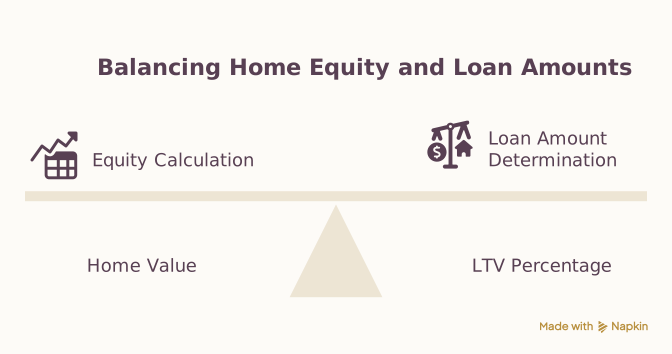
Home value minus mortgage balance is arithmetic equity. A CLTV scenario reserves part of that value, and actual proceeds can be lower after underwriting and costs.
Two Calculations, No Eligibility Promise
First, the tool multiplies estimated home value by your entered combined-LTV percentage and subtracts the existing mortgage balance. A negative amount is floored at zero. Second, it amortizes the requested home equity loan as a separate fixed-rate installment loan. It reports whether the request fits the entered threshold only as arithmetic; it does not know a lender's limit or your qualification.
Home Equity Loan Examples
Request below entered 80% CLTV
Property and fixed-loan assumptions
LTV and payment estimate
The modeled combined balance is $375,000, or 75% of the entered home value.
No capacity at entered threshold
Property and fixed-loan assumptions
LTV and payment estimate
The payment is still shown for comparison, but the request exceeds the user-entered threshold and does not imply availability.
Check every lien and cost
A lender's combined balance may include other liens, and net proceeds may be reduced by transaction costs.
Frequently Asked Questions
Still have questions about this calculation?
Try the CalculatorHome Equity, CLTV and Payment Formulas
The capacity estimate uses an entered combined-LTV percentage; the payment uses standard fixed-rate amortization.
Formula
Arithmetic equity
home value − existing mortgage balance
Available at entered CLTV
max(0, home value × entered CLTV − existing mortgage balance)
Resulting CLTV
(existing mortgage + requested loan) ÷ home value × 100
Fixed payment
PMT = P × r / (1 − (1+r)^−n)
Scientific Background
CFPB describes home equity loans as borrowing secured by home equity and explains that costs and risks matter. The Federal Reserve describes loan-to-value as a loan amount relative to property value. This calculator turns only entered assumptions into arithmetic estimates.
Sources & review
Home Equity Loan Calculator documents the references behind its formulas and assumptions. Always treat results as educational estimates, not personalized professional advice.
Last reviewed
July 21, 2026
Consumer financial tools
Consumer Financial Protection Bureau (CFPB)
https://www.consumerfinance.gov/ask-cfpb/what-is-a-home-equity-loan-en-106/Reference
federalreserve.gov
https://www.federalreserve.gov/frrs/guidance/high-loan-to-value-residential-real-estate-lending-interagency-guidance.htmFree Calculator Hub methodology
Free Calculator Hub
/methodology
See our methodology and corrections policy.